
WorkLattice
Structural Visibility for Strategy Execution
Organisations rarely fail because they lack strategy. They fail because the structure responsible for executing that strategy cannot reliably produce the outcomes that were declared.
Policies exist. Responsibilities are assigned. Governance frameworks are documented. But behaviour follows the decision architecture actually embedded in the organisation, not the one described in diagrams.
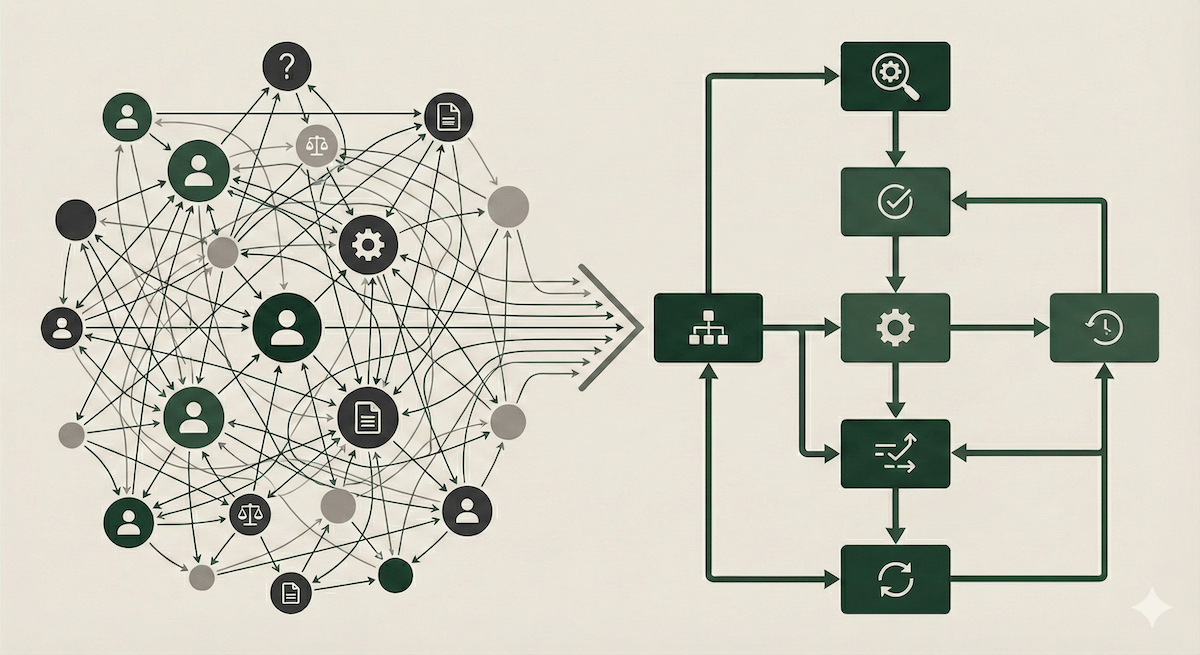
WorkLattice models decision architecture as a directed graph and applies graph-theoretic algorithms to detect structural failure signatures in documented governance designs.
It ingests your governance documentation via the Claude API, extracts the decision structure embedded in policies, delegations, and operating model artefacts, and runs diagnostic analysis against a formal library of twenty-four structural failure patterns across six diagnostic dimensions.
What is WorkLattice
Decision Architecture Analysis
Translate governance documentation into a structural map of how authority, verification, and escalation actually flow through the organisation.
WorkLattice reads the decision architecture embedded in your documented design, not inferred from interviews or observation, and makes it visible as a directed graph of relationships, dependencies, and control points.
Structural Pattern Detection
Analyse the decision architecture to detect structural failure signatures before they produce operational consequences.
WorkLattice identifies authority gaps, broken execution chains, escalation dead-ends, and decision bottlenecks as graph-theoretic properties of the documented design, not interpretive judgements. Each finding is classified by type, severity, and location in the architecture.
Understand where execution pathways are structurally resilient, fragile, or overloaded.
WorkLattice surfaces the conditions shaping organisational behaviour at the design level, giving leaders a clear basis for governance redesign, operating model changes, and AI deployment decisions that will hold under operational load.
Execution Structure Insight
Why is WorkLattice Useful
In complex organisations, execution problems are routinely attributed to leadership, culture, or individual performance. Many persist because they are structural: embedded in governance documents and operating model designs that nobody has analysed as a system.
When decision pathways are fragmented, responsibilities overlap without resolution logic, or escalation cannot reach a point with actual authority, the organisation behaves according to those structural constraints regardless of intent or effort.
WorkLattice makes those conditions visible from the documented design itself, before a transformation is scoped, before an AI deployment is architected, and before the next reorganisation embeds the same failure patterns in a new structure.
Who Uses WorkLattice
WorkLattice is used by strategy and transformation leaders in complex organisations: large enterprise, government, and institutional settings where execution failure is costly and governance documentation already exists.
It is also used by advisors, operating partners, and consulting teams conducting structural due diligence or pre-transformation diagnostic work.